
Why verifying business identity is a fundamentally different challenge
When a small business applies for a working capital loan, the lender is not verifying a single identity, but several. It must validate the business itself, its director(s), any additional decision-makers and, in many cases, the holding company that ultimately controls the structure.
The KYC (Know Your Customer) was designed to verify the identity of an individual. KYB processes, or business identity verification, involves simultaneously verifying all these stakeholders through multiple data sources, while complying with different regulatory requirements at each level. Applying a KYC logic to a business is like trying to assess a company solely through its director’s passport: it may verify one element, but it leaves out everything else.
Fraud figures highlight the real cost of this incomplete approach. In 2024, fraud related to SME financing increased by 13.6% year-over-year. The most common cases involved the impersonation of legitimate businesses as well as the theft of business owners’ identities.
What is KYB in Business Financing?
The KYB processes refers to the process of verifying a company’s legal existence, ownership structure, beneficial owners and business activities before providing financing. It is part of the broader Customer Due Diligence (CDD) Customer Due Diligence (CDD) framework, which requires financial institutions to know and assess their business customers.
In Europe, KYB requirements have progressively increased as a result of several regulatory developments aimed at combating money laundering, terrorist financing and financial fraud.
The main regulatory milestones include:
- The 4th and 5th European Anti-Money Laundering Directives (AMLD4 and AMLD5) strengthened financial institutions’ obligations regarding the identification and verification ofUltimate Beneficial Owners – UBOUltimate Beneficial Owners (UBOs). Lenders must identify the individuals who own or control a company, generally based on an ownership threshold of 25% or more, as well as any person exercising effective control over the entity.
- The The 6th Anti-Money Laundering Directive (AMLD6) and the gradual creation of national beneficial ownership registers have further increased transparency around companies’ ownership structures. However, these registers do not replace financial institutions’ due diligence obligations: lenders must still verify the information collected and ensure its reliability, particularly when granting credit.
For players involved in B2B financing, SME lending and working capital financing, these requirements apply to virtually all businesses seeking funding: commercial companies, SMEs, startups, self-employed professionals and groups with complex ownership structures.
KYB is therefore not simply about confirming that a company exists. It enables lenders to understand who is truly behind an organisation, how it is legally structured, what its risk profile is, and whether it can enter into a secure financial relationship..
KYB vs. KYC: Data sources, verification levels, failure rates and regulatory requirements
The table below highlights the structural differences between these two processes and explains why a traditional KYC workflow cannot fully address KYB requirements without creating compliance gaps.
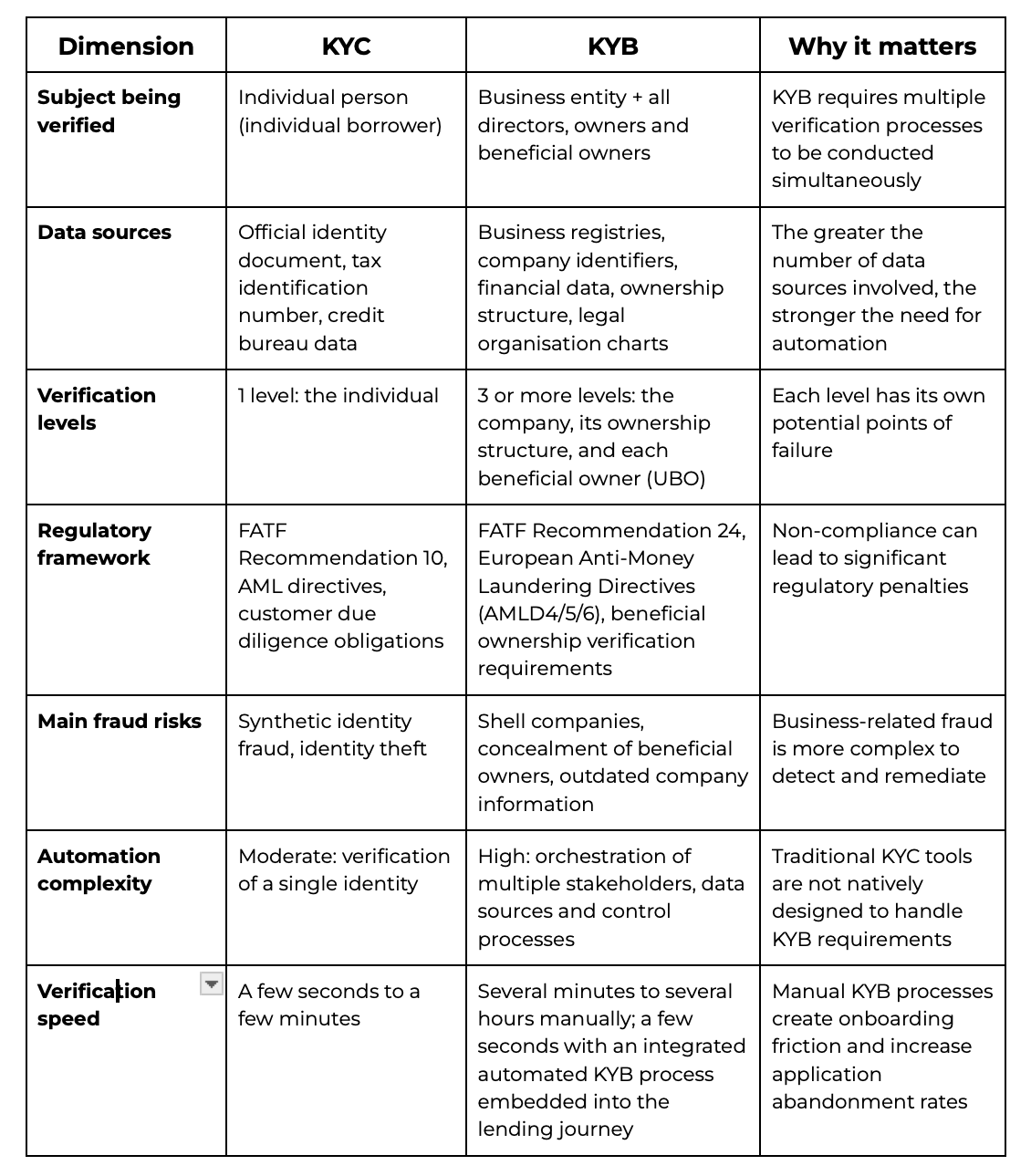
A company owned by three equal shareholders (33% each) requires three individual KYC verifications as part of a complete KYB process.
Compliance teams that still treat these controls as two separate processes operating in silos often overlook this critical interconnection. The disconnect between verifying the company and verifying the individuals who control it is one of the key weaknesses identified during Anti-Money Laundering (AML) framework audits.
The six levels of verification a KYB process must cover
A complete Know Your Business (KYB) process relies on six complementary verification levels. Each one uses different data sources and presents its own risks if controls fail. However, most credit management or onboarding solutions only cover part of these checks.
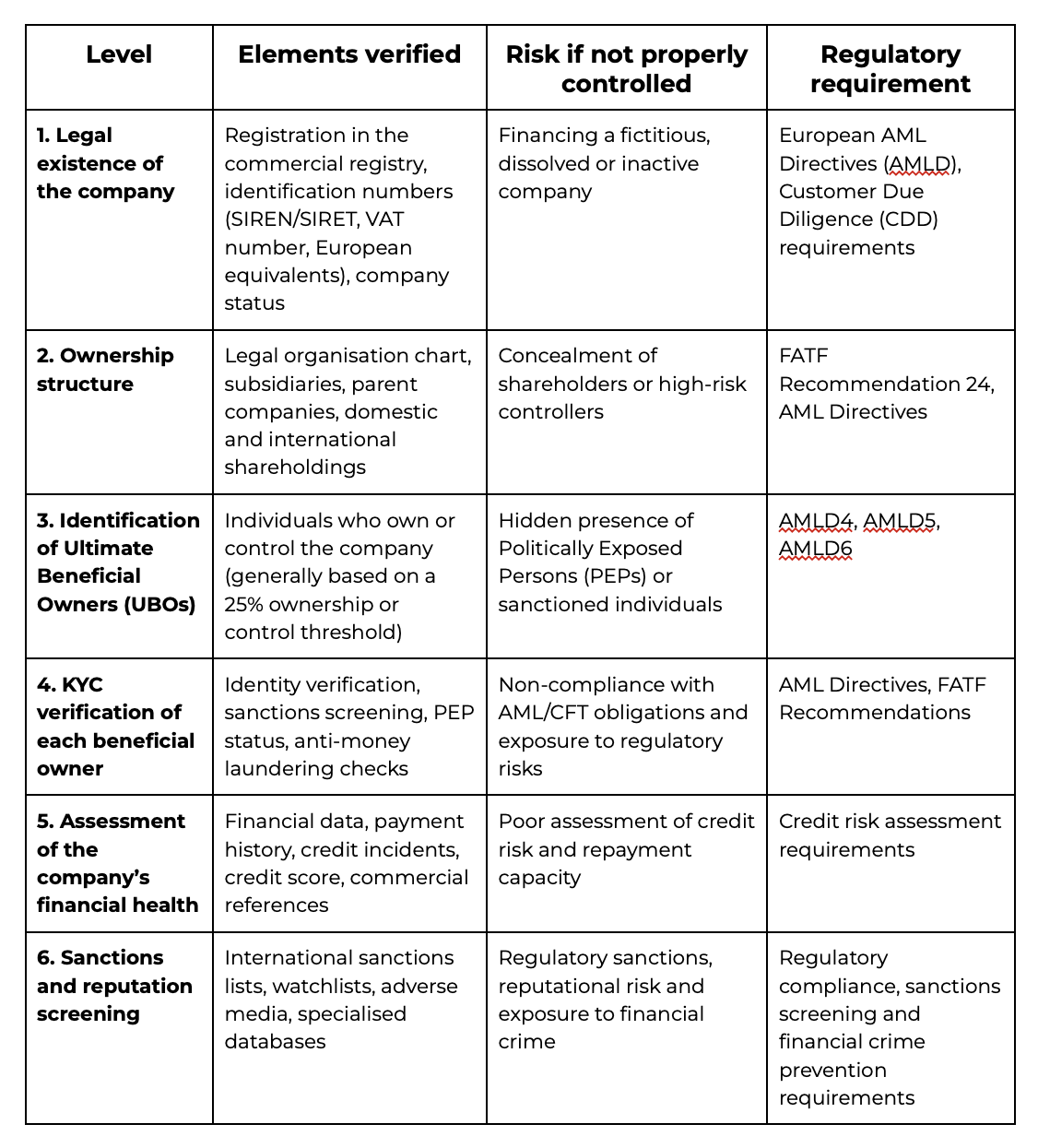
Each of these controls can fail independently from the others.
A company can be fully and legally registered (level 1) while concealing its beneficial owners behind a complex ownership structure (levels 2 and 3). Similarly, a reputation check (level 6) may uncover legal proceedings, suspected fraud or links to illicit activities that do not appear in any official registry.
This is why a robust KYB process cannot be limited to verifying whether a company legally exists. It must combine all six levels of verification to provide a complete risk assessment, meet European regulatory requirements and secure credit approval decisions.
The limitations of traditional credit origination platforms
Most Loan Origination System (LOS) were originally designed for consumer lending. When they are used to finance SMEs or provide B2B deferred payment solutions, several limitations quickly become apparent.
The main limitations include:
- Limited integration with business data sources – Few platforms natively connect to European business registries, financial databases or commercial credit data providers.
- KYC journeys designed for a single individual – Processes are built to verify the identity of one person, whereas a KYB journey must simultaneously assess the company, its directors, beneficial owners (UBOs) and sometimes multiple levels of parent companies.
- Inflexible verification rules – Verification requirements vary depending on the legal structure (sole trader, LLC, simplified joint-stock company, public limited company, foreign company, international group, etc.). General-purpose platforms rarely provide sufficiently configurable rules to automatically adapt controls to each situation.
- AML checks performed outside the decision-making process – Sanctions screening, Politically Exposed Person (PEP) checks and adverse media monitoring are often carried out manually or through external tools, rather than being directly integrated into the decision engine.
- Insufficient auditability and traceability – While credit decisions are generally recorded, the steps leading to the validation of a company’s identity are much less frequently documented. Yet this audit trail is essential to demonstrate compliance during regulatory reviews.
The result is a fragmented KYB process precisely where the main fraud and compliance risks emerge.
KYB should therefore not be considered an additional step added to the credit origination journey. It must be natively embedded into every stage of the decision-making process, from onboarding through to final approval.
The operational and regulatory costs of KYB failures
KYB deficiencies are no longer just an operational risk. They can now result in significant financial and regulatory consequences.
Across Europe, the continued strengthening of Anti-Money Laundering (AML) regulations, international sanctions requirements and expectations from national authorities (ACPR, BaFin, FCA, Bank of Spain, etc.) is increasing the pressure on financial institutions and B2B financing providers.
Insufficient verification can lead to several consequences:
- financial penalties imposed by supervisory authorities,
- enhanced regulatory reviews and remediation requirements,
- increased losses linked to fraud,
- reputational damage for the financial institution,
- longer onboarding times and lower conversion rates for financing applications.
Beyond regulatory fines, the hidden costs are often the most significant: increased manual reviews, slower compliance operations, degraded customer experiences and lost business opportunities.
The new challenge: AI-Powered Business Identity Fraud
Document verification alone is no longer enough.
The rise of Generative AI (GenAI) now makes it possible to produce highly convincing business documents, including articles of incorporation, company registration extracts, financial statements, identity documents and even manipulated verification videos (deepfakes).
As a result, lenders can no longer rely solely on the documents submitted by applicants.
Instead, they must systematically cross-check this information against official and independent data sources, such as:
- national business registries,
- beneficial ownership registers (where accessible),
- tax authorities,
- business information and corporate data providers,
- international sanctions databases and Politically Exposed Person (PEP) lists.
In other words, trust should no longer be placed in the document itself, but in the data obtained directly from its official source..
Paradoxically, the same artificial intelligence technologies that make fraud easier to commit can also strengthen fraud prevention. When embedded within a modern lending platform, AI can automate KYB verification, detect inconsistencies across multiple data sources and accelerate credit decisions without compromising regulatory compliance.
How RollingFunds embeds KYB into the B2B Lending journey
The real challenge is not the lack of Know Your Business (KYB) solutions on the market. It is the absence of a lending platform capable of automatically orchestrating these checks within the credit decisioning process itself.
When performed as a separate or manual step, KYB increases processing times, multiplies manual interventions, weakens the audit trail and raises the risk of non-compliance during regulatory audits.
This is why integrations with third-party data providers should not be viewed as simple connectors, but as native components of the credit origination workflow.
Through its technology infrastructure, RollingFunds connects to the key data sources used for business identity verification and risk assessment, including:
- official business registries,
- financial and commercial credit data providers,
- international sanctions databases,
- Politically Exposed Person (PEP) lists,
- KYC/KYB data providers,
- Open Banking and credit scoring solutions.
All of these checks are performed automatically as soon as a financing application is submitted.
The decision engine then uses this information in real time to:
- verify the company's legal existence,
- identify its Ultimate Beneficial Owners (UBOs),
- screen directors and shareholders,
- detect sanctions matches and AML alerts,
- assess the company's creditworthiness,
- generate a credit decision aligned with predefined risk policies.
As a result, risk and compliance teams have access to a complete case file documenting every verification performed, without having to launch manual checks across multiple platforms.
Every action—whether automated or performed by an analyst—is fully logged to provide a comprehensive audit trail that meets the expectations of regulators and supervisory authorities.
Why KYB is essential for B2B Lending
Working capital financing, deferred payment and B2B Buy Now, Pay Later (BNPL) solutions rely on credit decisions being made quickly—sometimes within seconds.
In this environment, a manual KYB process creates a difficult trade-off:
- faster business onboarding,
- or controls are simplified, increasing compliance and risk exposure.
Embedding KYB directly into the decision engine transforms a regulatory obligation into an operational advantage.
The benefits are significant:
- acceleration of business onboarding,
- fewer manual verification tasks,
- higher financing application conversion rates,
- stronger fraud detection,
- improved compliance with European Anti-Money Laundering (AML) and Customer Due Diligence (CDD) requirements.
Key Criteria for Evaluation a KYB Solution
Several capabilities distinguish a true KYB engine from a simple compliance module. A robust solution should provide:
- Automatic verification of the company's legal existence through official business registries.
- Automatic identification of Ultimate Beneficial Owners (UBOs) , along with KYC verification for each of them.
- Access to financial data and creditworthiness information from specialised business data providers.
- Automated screening against sanctions lists, Politically Exposed Person (PEP) lists and watchlists for both the company and its beneficial owners.
- Adverse media screening to identify reputational risks, ongoing legal proceedings or potential financial crime concerns.
- Configurable verification rules based on the company's legal structure, country of incorporation or customer risk profile.
- A complete audit traildocumenting every step of the KYB process and all decisions taken.
- Real-time orchestration , enabling verification results to feed directly into the decision engine and credit scoring models.
Conclusion
The Know Your Business is fundamentally more complex than Know Your Customer.
While KYC focuses on verifying the identity of an individual, KYB requires lenders to understand the entire organisation behind a business—its legal structure, Ultimate Beneficial Owners (UBOs), directors, ownership relationships and the risks associated with each of them.
Across Europe, requirements stemming from the Anti-Money Laundering Directives (AMLD), Financial Action Task Force (FATF) recommendations and national regulations now require financial institutions to implement increasingly robust business verification and due diligence processes.
The organisations that will succeed in scaling B2B lending over the long term will be those that embed KYB at the core of their technology infrastructure—not as a standalone compliance requirement, but as a strategic capability that improves operational efficiency, strengthens risk management and delivers a faster, more seamless customer experience.


