
30-, 45-, and 60-day payment terms are the norm in B2B commerce, not the exception. Yet most B2B distributors and sellers (both offline and online) still require immediate payment at checkout. The result is predictable: cart abandonment, a strong return to offline channels, and a digital experience that fails to deliver on its promises.
Deferred and installment payments are not marketing gimmicks borrowed from B2C. They are measurable commercial levers. They align the digital experience with what professional buyers have always expected.
Why do professional buyers expect flexible payment terms?
In traditional B2B commerce, immediate payment is the exception. A restaurant owner ordering from a food wholesaler does not pull out a corporate credit card. They receive a 30-day invoice.
A procurement manager ordering industrial equipment does not make a bank transfer the same day either. They operate with negotiated payment terms of 30, 45, or even 60 days. This model structures the majority of professional sectors.
But one distinction is essential. In B2C, installment payments are largely psychological: they allow consumers to spread out a personal expense to reduce its immediate impact. In B2B, the issue is fundamentally different.
It is not about individual consumer psychology, but about cash flow management, budgeting cycles, and aligning purchases with payment flows. A procurement manager does not walk away from a €15,000 order because they fear the expense.
They hesitate because the immediate cash outflow was not budgeted for this month. This is not a cosmetic detail: it is precisely what explains the structural impact of flexible payment terms on conversion.
And this is not only relevant for large baskets. That distinction is central to everything that follows.
The gap becomes obvious as soon as these buyers land on a B2B e-commerce site or interact with an offline sales process. At checkout, they are asked to pay immediately: card, bank transfer, or nothing. Within seconds, the digital experience becomes objectively inferior to a simple phone call with a sales representative, where standard payment terms are automatically applied.
This is not because digital is less convenient, but because it does not give them access to what they consider standard: their usual payment terms. As long as this gap remains, professional buyers will continue to favor trusted partners that offer those conditions.
How do installment payments increase B2B conversion rates?
Reducing cart abandonment at checkout
In many B2B environments, cart abandonment stems from a simple mismatch: the payment terms offered do not align with standard intercompany credit practices.
The buyer has already identified their need, compared solutions, and selected products. The friction appears at the payment stage, because an immediate cash outflow does not fit within that month’s budget.
Available data confirms this phenomenon. Most figures come from solution providers themselves, reflecting a market that is still relatively young. However, the overall trends are consistent.
Across the sector, merchants offering B2B BNPL solutions report an average 36% increase in conversion rates. Cart abandonment can decrease by as much as 29%.
Accelerating purchasing decisions
Immediate payment requirements in B2B often trigger an internal approval process. The operational manager must obtain validation from the finance department.
Finance teams verify budget availability, request justifications, and schedule the payment. This cycle can take several days or even several weeks for large orders.
Deferred payment helps remove this bottleneck. When the cash outflow is postponed by 30, 60, or 90 days, it aligns with the company’s standard budgeting cycles. Urgent financial approval is no longer a prerequisite.
Operational decision-makers can validate orders without immediately involving finance or treasury teams. The sales cycle becomes shorter, and orders are completed faster.
The impact of deferred and installment payments on average order value (AOV)
Purchasing power unlocked by flexible payment terms
A procurement manager operates within monthly budget allocations. If the available budget for the month is €20,000 and immediate payment is required, they simply cannot exceed that limit.
Payment terms change this constraint. With 60-day terms, an order placed this month is charged against the budget two months later. The company’s effective purchasing power increases without changing its actual cash position.
Orders that would previously have been split across several months can now be consolidated into a single purchase. Volumes that were once constrained by immediate cash requirements become accessible.
With installment payments, the effect is even more significant. Four payments of €1,000 are easier to pass through internal approval thresholds than a single €4,000 payment.
This is not a psychological lever in the way it is in B2C. It is a matter of budget governance. Each installment falls into a different accounting period and remains below automatic approval thresholds.
One of our clients illustrates this dynamic well. The construction materials distributor observed a 2.5x increase in average order value among customers after integrating a B2B BNPL solution.
The value of the products did not change. Their customers’ effective purchasing power did.
Additional purchases driven by flexibility
Once the constraint of immediate payment disappears, purchasing behavior changes. The mindset shifts from “What can I afford to pay for right now?” to “What do I actually need?”
This shift leads to more complete orders.
Installment payments reinforce this effect by reducing pressure on each budgeting cycle.
A professional buyer placing monthly supply orders without the constraint of an immediate cash outflow is more likely to add products they would normally postpone. They complete the order instead of reducing it.
They anticipate short-term needs rather than limiting themselves to the bare minimum.
Across the sector, businesses report an average 45% increase in average order value among professional buyers.
The conversion barriers that flexible payments eliminate
The requirement for immediate payment
This mechanism works for individual consumers. It fails when applied to professional buyers managing recurring orders within corporate budgeting cycles.
Immediate payment is not neutral. It is an active source of friction. It excludes buyers whose internal processes do not allow for instant spending.
It also penalizes large orders, where an immediate cash outflow requires managerial approval. And it creates an asymmetry between what an e-commerce platform offers and what offline channels provide by default.
Internal approval cycles on the buyer side
In an SME or mid-sized company, a significant B2B order rarely involves just one person. The operational manager identifies the need. Procurement validates the supplier and the terms.
Finance verifies the budget and authorizes payment.
This process exists for good reasons: control, traceability, governance. but it lengthens the time between the purchase decision and the actual order.
Immediate payment triggers this entire approval chain. Deferred payment simplifies it. Because the cash outflow is postponed, urgent financial validation is no longer required. Operational decision-makers can place orders within their normal approval authority.
The sales cycle becomes shorter. Conversion rates increase.
The experience gap between digital and traditional channels
An experienced professional buyer evaluates an e-commerce site using a simple benchmark: “Is this better or worse than calling my sales representative?”
If the answer is “worse,” they revert to the offline channel. This typically happens when the salesperson can offer payment terms that the website cannot.
This logic explains why many B2B companies invest heavily in UX, product catalogs, and search capabilities, while still struggling to migrate customers online. A report from Sana Commerce indicates that 73% of B2B buyers prefer purchasing online. The ordering experience is superior on almost every level, except one: payment.
That single issue is enough to keep a portion of buyers tied to traditional channels. Flexible payment terms eliminate this final point of friction.
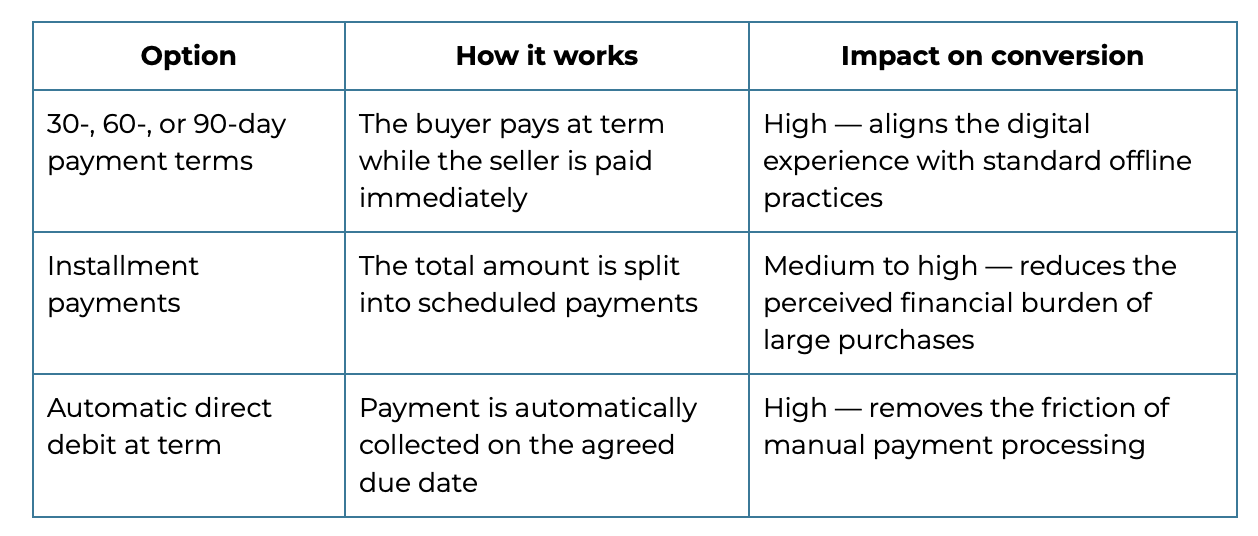
B2B payment options and their impact on conversion
30-, 60-, or 90-day payment terms
The buyer receives the goods or services immediately and pays on the agreed due date. This option mirrors traditional B2B practices. It requires no behavioral change on the buyer’s side: they order as they normally would, with the payment terms they already expect.
For the merchant, this model is only viable if cash flow is secured. In an embedded finance model, a financial partner advances the funds to the merchant immediately.
The buyer pays in 60 days. The seller gets paid within 24 hours. Both parties get what they need.
Installment payments
The total amount is divided into several installments, typically two, three, or four payments spread over 90 to 180 days. This structure is particularly effective for large orders, where a single payment represents a significant expense.
Installment payments also act as a lever for increasing average order value. A buyer who hesitates to commit €8,000 in a single payment will more easily move forward when the amount is spread across three monthly installments.
The impact on average order value is direct and well documented.
Automatic direct debit at term
The buyer authorizes an automatic debit on the agreed due date. This option removes the need for any manual payment action on the buyer’s side: no bank transfer to initiate, no invoice to retrieve, no missed deadlines. Payment is automatically executed on the scheduled date.
For the merchant, the benefit is symmetrical: no reminders, no manual follow-up, and no late-payment management. Collections become automated.
When to offer deferred payment, installment payments, or both
Not every payment option fits every context. Here is a practical framework to guide the decision.
Deferred payment (30, 60, or 90 days)
Deferred payment is best suited for recurring buyers with established invoicing habits. It fits segments where intercompany credit is already standard practice and where the commercial relationship is well established. It requires minimal behavioral change from the buyer: they order exactly as they already do today.
Installment payments
Installment payments are particularly suited to large orders or CapEx-type purchases. They work well for occasional buyers, customer acquisition phases, or product categories where order values exceed standard approval thresholds.
Splitting payments significantly reduces friction on high-value baskets without requiring a full commitment to traditional deferred payment terms.
Automatic direct debit at term
Automatic direct debit at maturity works especially well for high-volume recurring B2B transactions and subscription-based models. It is most relevant in contexts where reducing the operational burden of collections is a priority.
The key variables for choosing the right setup
Order value:
- Below €1,000: simple deferred payment is usually sufficient
- Above €5,000: installment payments become a major conversion lever
Purchase frequency:
- Recurring buyers tend to prioritize simplicity (automated 30-day terms)
- Occasional buyers or new customers tend to value flexibility (installment payments)
Customer segment:
- SMEs generally prefer installment payments due to tighter cash flow constraints
- Mid-market companies and large enterprises prioritize alignment with their budgeting cycles (60- or 90-day terms)
Gross margin
Financing costs have a direct impact on margins. In low-margin categories, the economic equation can quickly become unfavorable.
There is no universal setup. The most effective approach is to start with the option that most closely matches buyers’ existing purchasing habits. Then measure adoption rates and conversion impact before gradually expanding the payment offering.
The limitations to consider
Offering flexible payment terms comes with real costs and operational constraints. Ignoring them inevitably leads to operational surprises.
Financing has a direct impact on margins. The financial partner charges fees on each transaction. It is therefore essential to ensure that the conversion uplift offsets these costs, particularly in low-margin categories.
Not all buyers will be eligible. Some will fail the credit assessment process. It is critical to provide a clear fallback experience to avoid degrading the user journey at this stage.
Overly broad eligibility criteria can also attract riskier buyer profiles. This increases default rates and may negatively affect the commercial terms negotiated with the financing partner.
How to offer flexible payments with zero credit risk
Offering flexible payment terms is one thing. But one key question remains: who finances the cash flow gap? And who bears the risk if the buyer fails to pay?
The answer depends entirely on the model being used. Here is how RollingFunds structures the process end to end.
Assessing the buyer’s creditworthiness, not the seller’s
Modern financing models reverse the traditional logic of intercompany credit. In traditional factoring, the seller is the one being assessed. This approach mechanically excludes small suppliers and new entrants, precisely the businesses that need financing the most.
RollingFunds evaluates the buyer instead: the party that actually has to pay..
If the buyer is creditworthy, the seller gets paid regardless of the seller’s own financial situation. RollingFunds evaluates the debtor in real time using financial, behavioral, and regulatory signals. According to the company, 92% of decisions are made instantly, without requiring any documentation from the seller.
The buyer is assigned a dynamic financing limit that adjusts based on payment history and financial health. This is not a fixed decision: the limit evolves daily and adapts transaction by transaction.
Off-balance-sheet financing
The mechanism is straightforward: the merchant offers payment terms to buyers. RollingFunds immediately advances the funds to the merchant, typically within 24 hours.
The buyer then repays RollingFunds on the agreed due date through automatic direct debit.
For the merchant, the balance-sheet impact is neutral. No capital is advanced, no credit line is used, and no receivables remain outstanding on the balance sheet. Integration is handled through a REST API.
The entire financial cycle is managed by RollingFunds. No lending license is required. No capital is tied up. No counterparty risk is carried by the merchant.
Full collections management and default risk coverage
RollingFunds does not simply advance funds: it purchases the receivable outright. This distinction is critical. If the buyer fails to pay, RollingFunds reportedly absorbs 98% of the loss.
The company manages the entire post-invoicing cycle: automated collections at maturity, dispute management, and default monitoring. The merchant can offer payment terms to customers while being paid immediately, without handling reminders, collections, or legal recovery procedures.
What high-performing B2B merchants do differently with RollingFunds
The most successful B2B merchants don’t treat payment terms as a peripheral option. They design the entire purchasing journey around them, embedding flexibility directly into the customer experiencerather than adding it as an afterthought.
Payment terms visible throughout the buying journey
Eligibility for flexible payment options is shown during checkout, not after. Buyers immediately understand whether they qualify for payment terms at the moment of purchase. This removes uncertainty at the critical decision point and prevents drop-offs caused by ambiguity.
No redirection to third parties
The experience remains fully embedded within the merchant’s brand environment. There are no external credit forms or separate application flows. The entire process stays seamless and continuous, preserving trust and reducing friction.
Instant eligibility decisions
Buyers receive an immediate answer on whether they are eligible for flexible payment terms. No waiting, no manual review. Credit decisions happen in real time, eliminating delays at checkout.
Immediate payment to the merchant
The seller is paid within 24 hours, regardless of the payment terms granted to the buyer. The cash flow gap is absorbed by the financing infrastructure, not by the merchant’s balance sheet or working capital.
Fully automated collections at term
No manual invoicing, no payment chasing. Repayment is automatically collected at the agreed due date. The entire post-purchase financial workflow is automated, from issuance to settlement.
Key metrics to measure impact
Deploying flexible payment options without measurement is like navigating blind. The following are the essential KPIs to track from launch:
- Checkout conversion rate: compare performance with and without deferred payment options over the same period
- Approval rate: share of buyers requesting financing who are successfully approved
- Adoption rate: proportion of eligible buyers who actually use the offered payment terms
- Average order value (AOV): compare flexible-payment users versus immediate-payment users
- Repeat purchase rate: frequency of purchases from customers using flexible payment terms
- Post-financing gross margin: ensure that the conversion uplift offsets financing costs
- Default and dispute rate: essential monitoring even when risk is transferred to the financial partner
- Effective time-to-cash for the seller: confirm that immediate payment is effectively maintained
These indicators help distinguish between an implementation that genuinely creates value and one that merely shifts risk or erodes margin.
These principles are not theoretical. They describe an operational architecture already used by the most advanced B2B merchants.


