Building materials merchants face a dilemma: grant “30 days end of month” terms to win accounts, or demand payment upfront and watch customers drift to more flexible competitors. With 82% of construction companies waiting more than 30 days to get paid, and an average payment period of over 50 days in the construction sector, cash flow pressure can weaken even profitable merchants. B2B deferred and split payment changes the game: the merchant is paid on the invoice, while its trade customer keeps its 30 days end of month, or even longer.
Understanding “30 days end of month” for building materials merchants
“30 days end of month” gives the trade customer until the end of the month following the invoice to pay. An invoice issued on March 10 is therefore due on April 30, which amounts to 20 to 50 days of actual credit depending on the invoice date. Late payment penalties, the €40 fixed recovery fee and any early payment discount depend on the supplier’s general terms of sale and credit policy.
The mechanism rests on four elements:
- the invoice date, which sets the starting point of the payment period,
- the due date, set at the last day of the following month,
- the late payment penalties set out in the terms of sale,
- an authorized credit limit, which caps the amount owed by each customer.
For a merchant, these terms meet a real need. General contractors and tradespeople often wait to be paid by the project owner before paying their suppliers. Materials account for a large share of a project’s cost: without supplier credit, many businesses simply cannot front them.
The difficulty lies in the gap between contractual terms and actual behavior. In France, the law caps payment terms (60 days from invoice date or 45 days end of month at most), but late payments remain common in construction: the average payment cycle reaches 57 days before any delay even occurs, so “30 days end of month” often turns into 90 days of actual collection, or more.
The challenge: granting 30 days end of month without drying up cash
The impact of payment terms on a merchant’s cash flow
The equation is relentless. When you deliver concrete, steel or timber today and get paid in 45 to 90 days, your business has to finance in the meantime:
- wages for yard, logistics and delivery teams,
- stock purchases, often paid faster to your own suppliers,
- operating costs: rent, energy, insurance,
- maintenance of the vehicle fleet and equipment.
This gap forces tough trade-offs. Many merchants draw on costly credit lines that eat into already thin margins. Others slow their growth by turning down orders they cannot finance, and watch competitors take market share.
The pressure spreads along the chain: 77% of subcontractors have already had to pay for materials out of their own funds while waiting to be paid. The entire industry is short of liquidity.
Why traditional solutions fall short
Bank overdrafts and credit lines. Heavy paperwork, personal guarantees, collateral, variable rates, approval times of several weeks. And customer receivables stay on your balance sheet.
Early payment discounts. They encourage faster payment, but assume the customer has cash available, which is rarely the case mid-project. They also cost margin.
Restricting credit. Requiring cash payment pushes customers toward the competition. With 86% of buyers considering payment terms essential, not offering credit terms means dropping out of most tenders.
Factoring. It speeds up invoice collection, but structures (with or without recourse), customer relationship handling and pricing vary widely from one factor to another. It steps in after the sale, without helping to close the sale itself.
B2B deferred and split payment: changing the cash flow equation
How RollingFunds works for a building materials merchant
With RollingFunds, the merchant no longer waits 45 to 90 days: it receives 100% of the amount (minus interest) within 24 hours, while its trade customer keeps its 30 days end of month, or spreads its payment over several installments.
- The trade customer places an order at the counter, with the sales administration team, by telesales, through a sales rep or online.
- The customer chooses deferred payment (30 days end of month) or split payment.
- RollingFunds checks eligibility and available credit, instantly for an already approved customer.
- The transaction is validated: by SMS code in e-commerce, via the extranet or the merchant’s own tools in assisted sales.
- The merchant is paid by RollingFunds, usually within 1 to 2 business days.
- The customer repays on the scheduled due date, directly to RollingFunds.
The cash flow gap disappears. A merchant delivering €50,000 worth of materials receives around €49,100 within a few days, instead of waiting two months or more.
Credit provided by a licensed institution, off the merchant’s balance sheet
At RollingFunds, all deferred and split payment offers are credit, provided by a licensed financial institution partner. It is neither factoring nor an invoice advance.
For a building materials merchant, the benefits are tangible:
- predictable cash flow, regardless of customers’ payment behavior,
- customer receivables off the balance sheet: the financial partner carries the credit,
- a clear cost model: interest and a guarantee reserve charged to the merchant, with the reserve held by RollingFunds rather than by the merchant,
- the customer relationship preserved: deferred payment is offered by the merchant, within its own sales channels,
- room to grow: taking on larger orders without exposing its own cash.
Managing risk: eligibility, credit limits and collections
Fast eligibility decisions
Traditional account opening for a trade customer slows sales down:
- trade reference calls that take days,
- multiple bank checks,
- business databases with thin coverage of small companies,
- spreadsheet tracking, prone to errors and inconsistencies.
With RollingFunds, RollingFunds decides on trade customer eligibility, in under 5 seconds and with no file for the merchant to put together. For a merchant, that speed matters: when a contractor needs 20 m³ of concrete for a Monday morning pour, waiting three days for credit approval means losing the sale.
Limits that grow with the customer
A fixed credit limit creates friction. A tradesperson capped at €25,000 may need €40,000 for a larger project. In a traditional system, that means a new application and more delays.
RollingFunds raises credit limits along a growth path, and the merchant can recommend limits for its best customers. Loyal customers can buy more, without adding to the sales administration workload or to risk management.
Collections are no longer the merchant’s job
Chasing a late-paying customer means balancing firmness with protecting the relationship: today’s slow payer may be tomorrow’s key account. With RollingFunds, the customer repays the credit to RollingFunds: the merchant no longer has to manage payment schedules, reminders and defaults on these sales. Manual accounts receivable work can drop by up to 50%, and DSO can fall by 15 to 20 days on average. Teams can focus on advice and sales.
B2B deferred payment vs factoring: what changes for a merchant
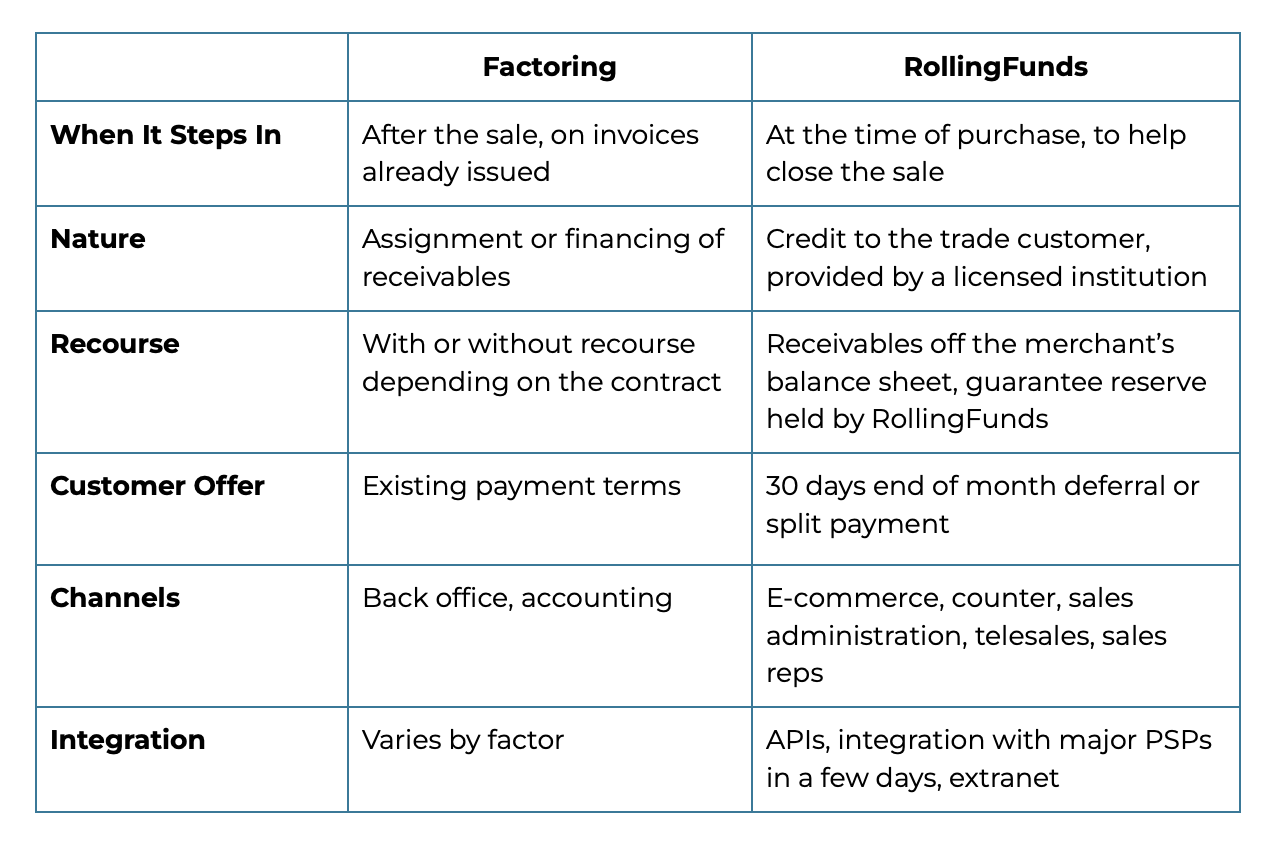
Beyond the financial setup, RollingFunds brings together customer eligibility, deferred and split payment, transaction validation and repayment tracking in a single solution. Fewer providers, less administrative complexity.
A seamless payment journey, at the heart of the merchant’s channels
Deferred payment wherever the customer buys
Tradespeople and construction companies expect purchasing journeys as simple as those in their personal lives. Phone calls, cheques and manual reconciliation frustrate them.
RollingFunds integrates into all of a merchant’s sales channels:
- in e-commerce, with transaction validation by SMS code,
- at the counter, in sales administration and telesales, via an extranet or integration with the merchant’s tools,
- in sales meetings, to offer deferral or split payment on a large quote,
- on the technical side, via APIs that integrate with most PSPs in a few days.
Preserving the relationship between the merchant and its customers
In the building materials trade, relationships often span decades. A poorly integrated financial intermediary can sow doubt.
With RollingFunds, the merchant is the one offering deferred payment to its customers, within its own sales journeys. The merchant enriches its service offering without losing the direct relationship its business depends on.
Real-world impact: 30 days end of month as a growth lever
They already offer deferred payment with RollingFunds
Leading names in building materials distribution and professional equipment rely on RollingFunds to offer deferred and split payment to their trade customers: La Plateforme du Bâtiment (a Saint-Gobain subsidiary), Raboni and Tout Faire Matériaux.
Expanding your market with flexible payment terms
The advantage goes beyond existing customers. A merchant offering 30 days end of month or split payment can:
- win deals previously lost to more flexible competitors,
- capture larger orders from tradespeople constrained by their own cash flow,
- build loyalty by supporting customers through the cash crunches of a project,
- grow without proportionally expanding its credit control and collections teams.
How RollingFunds helps merchants offer 30 days end of month with peace of mind
RollingFunds enables building materials merchants to offer 30 days end of month and split payment to their trade customers, without the burden falling on their cash flow.
- B2B deferred and split payment: the merchant gets paid, the customer keeps its payment terms or spreads its payments. The credit is provided by a licensed financial institution partner.
- Eligibility managed by RollingFunds: fast decisions, limits that grow with the customer, limits recommended by the merchant.
- All sales channels: e-commerce with SMS code validation, extranet or integration for sales administration, telesales and sales reps.
- Fast integration: APIs that integrate with most PSPs in a few days.
- 100% B2B, available in France, Belgium and Luxembourg, and soon in Spain.
For a building materials merchant, it means offering competitive payment terms while protecting working capital and lightening the workload tied to payment terms.