
The rise of financial technologies has profoundly transformed interactions between businesses and their partners. This upheaval has placed Fintech at the heart of a new ecosystem where transparency, responsiveness, and compliance are no longer optional — they are essential.
In this context, brokers play a strategic role: they act as commercial intermediaries, advisors, and guardians of the quality of business relationships. But to remain competitive and compliant, they must now rely on robust technological tools such as KYB (Know Your Business).
Faced with increasingly complex regulatory requirements and growing pressure to streamline the onboarding and verification of client businesses, KYB is becoming a vital part of their daily operations. More than just a compliance tool, it enables brokers to secure their operations, accelerate their sales cycles, and build trusted relationships with professional partners.
What Is KYB Technology and How Does It Work for Brokers?
Unlike KYC, which focuses on verifying the identity of individuals, KYB (Know Your Business) specifically applies to interactions between companies. It is an essential verification process for B2B players — especially brokers, who deal daily with a wide range of partner companies, clients, and suppliers.
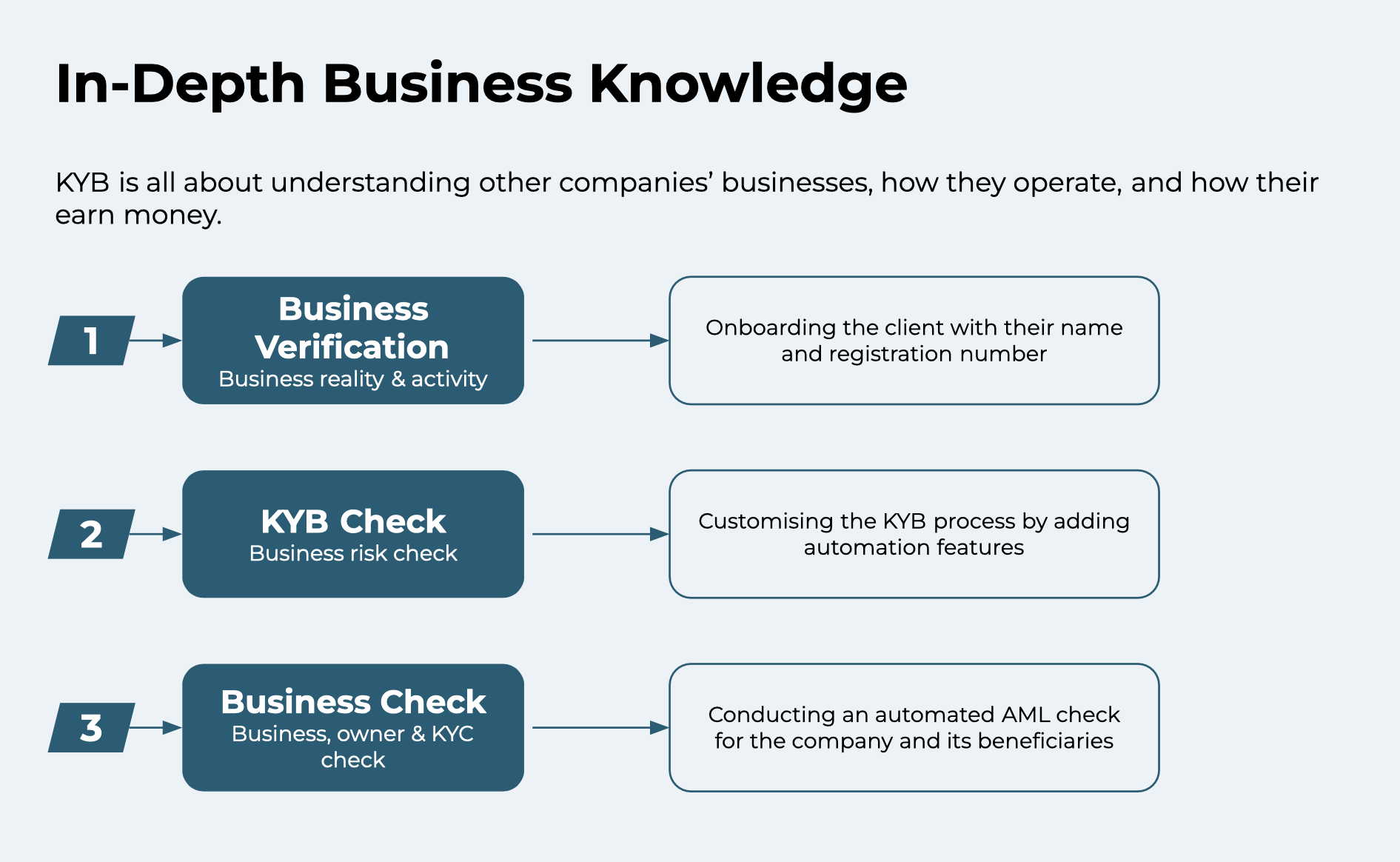
KYB makes it possible to:
- Verify the identity of a client or partner company: registration number, company name, legal address, legal structure, etc.
- Identify the individuals who manage and/or control the company: directors, legal representatives, ultimate beneficial owners (UBOs).
- Assess the risks associated with the business relationship: links to illegal activities, shell companies, regulatory pressure, financial sanctions, legal convictions, or reputational damage.
This process goes beyond simple document collection: it leverages official databases, sanctions lists, media sources, and increasingly, automated analysis tools.
Much like the technological evolution of KYC, KYB is currently undergoing a major transformation, driven by artificial intelligence and machine learning. These technologies enable:
- One Truly accelerated and continuous business monitoring ,
- Behavioral and transactional analysisbased on historical data,
- Proactive detection of weak signals of fraudulent activity,
- The Customized levels of due diligence according to each client or partner’s risk profile.
For brokers, this translates into a wide range of benefits:
- Faster onboarding of new professional clients,
- Reduced risk of regulatory non-compliance,
- Secured and more reliable B2B flows in an increasingly monitored environment,
- And most importantly, the ability to focus on commercial value.
Thanks to automation, KYB becomes less of a regulatory burden and more ofa competitive edge— combining compliance, operational efficiency, and business growth.
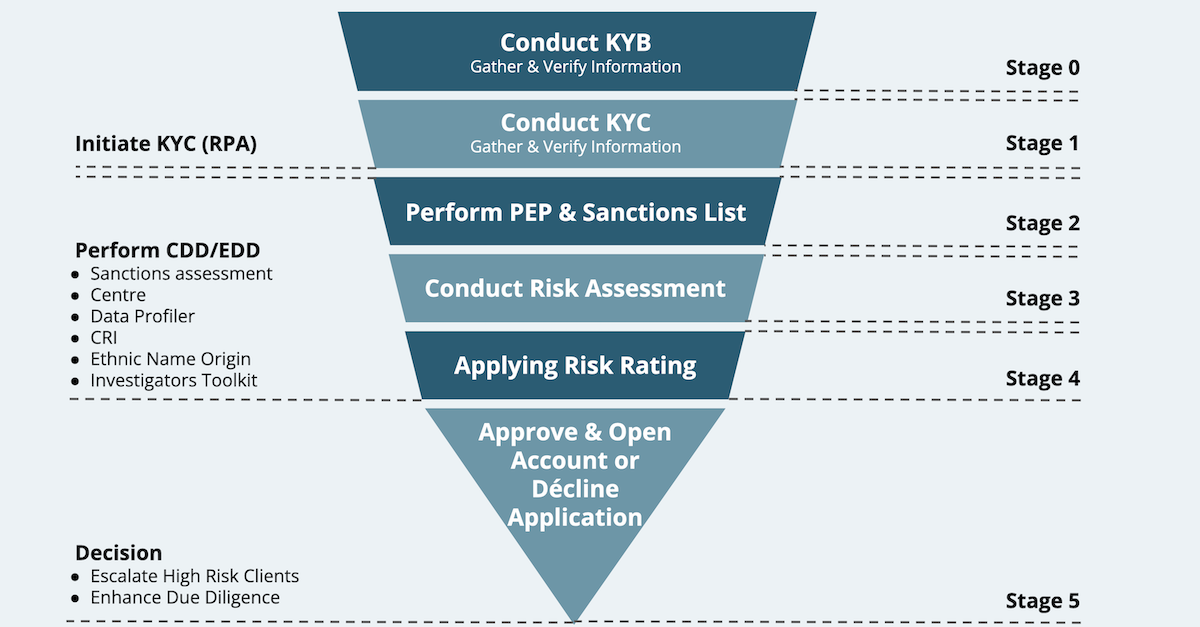
KYB: Specificities for Brokers
The KYB processes has become a key element in compliance frameworks for brokers. It aims to secure inter-company relationships (with insurers, business introducers, professional clients, and other partners) by ensuring the legality, transparency, and reliability of the entities they work with.
Its main goal: reducing the risk of exposure to illegal or fraudulent activities (money laundering, terrorism financing, identity theft, etc.).
A Process Adapted to the Brokerage Model
In the brokerage sector, KYB applies to various types of partners: insurers, intermediaries, wholesale brokers, or even client companies in the context of group contracts. The process relies on several key steps:
- Verifying the legality of the client and/or partner company
- Identifying Ultimate Beneficial Owners (UBOs) to ensure the company is not a front for hidden interests,
- Analyzing the ownership structure,
- Assessing the business relationship risk ,
- Ongoing monitoring: a B2B relationship is not assessed just once — it evolves and must be reviewed regularly.
Concrete Objectives for Brokers
Brokers must be able to:
- Confirm the legal existence and operational capacity of a professional client.
- Validate regulatory compliance of the relationship.
- Assess solvency and reputation to avoid reputational or legal risks.
- Centralize and log KYB data to meet regulatory requirements.
Sector-Specific Challenges:
- Diversity of clients and partners: brokers work with a wide variety of entities, sometimes small or administratively unstructured.
- Lack of standardization: there is no universal KYB process, and requirements vary by jurisdiction
- Multiple data sources: verification requires cross-referencing several databases
In summaryKYB is both a regulatory imperative and a driver of professionalism for brokers. It strengthens trust in B2B relationships, secures insurer partnerships, and prepares the brokerage industry for rising regulatory expectations. Its successful implementation depends on gradual industrialization, supported by technologies tailored to the broker’s operational reality.